[Download e-note]
Building a robotics company has a different clock to it. Hardware prototyping takes months per iteration. A mistake doesn’t get patched in a release; it shows up on a customer’s warehouse floor, and the damage travels fast in a small industry. And you are often selling something customers have no frame of reference for, because nothing quite like it has existed before.
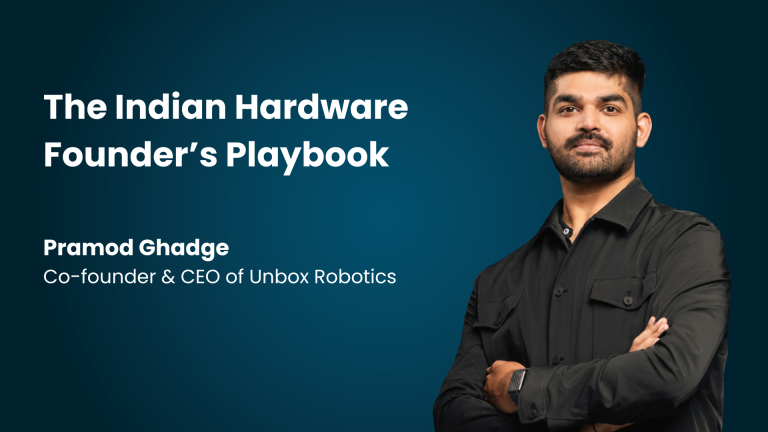
Pramod Ghadge has seen this first-hand. He is CEO and Co-founder Unbox Robotics, a Pune-based startup that builds modular software-defined robotic systems for warehouse sortation. Six years since its founding, Unbox has deployed 600-plus robots across eight to nine countries, with customers across India, Europe, and the US in e-commerce, fashion, and third-party logistics.
We recently hosted Pramod for a FoundrPwr session in which he shared the journey of building Unbox Robotics from first principles — from identifying a real warehouse automation problem during his time at Flipkart to scaling a robotics company across India and Europe. The discussion covered early customer discovery, commercialization, financing hardware businesses, expansion strategy, product thinking, hiring, and fundraising.
The core theme throughout the conversation was clear: deep-tech companies succeed when they stay obsessed with the following:
- Customer problem obsession: Stay focused on the problem and the metrics that matter to the customer, not on the technology for its own sake.
- Lean teams early on: Avoid over-hiring. In the beginning, generalists who can move quickly across functions are more valuable than a large, specialized team.
- Working capital discipline: In hardware, cash flow, vendor terms, customer advances, and inventory discipline can determine survival as much as the product itself.
- Extremely Focused Execution: Focus on a small number of customers. Concentrate on one or two regions. Make early deployments highly successful
- Support and uptime are mission critical.