Petrochemicals are the backbone of modern industry. They go into plastics and packaging, textiles, paints and coatings, pharmaceuticals, agrochemicals and even the cosmetics on our bathroom shelves.
India imports ~$88B of chemicals and petrochemicals every year. Close to 45% of the petrochemical intermediates we use are imported.
At the same time, India produces ~500M tonnes of crop residue every year, of which ~140M tonnes are estimated to be surplus. A significant portion of this is still burnt. This led us to a simple question:
“Can agricultural waste become a source of the molecules India currently imports?”
That is what drew us to altM.
Watch on YouTube: Turning Crop Waste Into the Chemicals India Imports | altM, Open in a new tab
From agricultural residue to specialty chemicals
Every plant is essentially made up of three structural polymers – cellulose, hemicellulose and lignin. Together, these can be converted into a wide range of chemicals and materials.
The challenge has always been extracting these components economically without destroying them in the process. This is where altM has built its technology.
Founded in Bengaluru in 2022 by Apoorv Garg and Yugal Raj Jain, altM is building a vertically integrated bio-specialty chemicals platform. Agricultural residue goes in at one end, and high-value functional ingredients come out at the other.
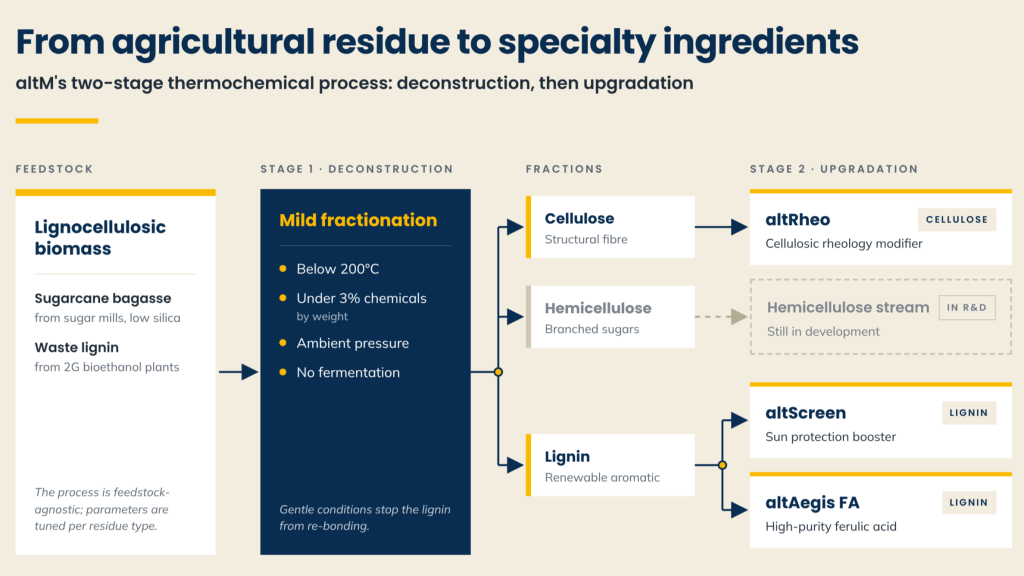
Its thermochemical process operates at low temperatures, uses very little added chemicals (3% by weight) and does not require fermentation. More importantly, it allows the different fractions of the biomass to be recovered without significantly degrading the lignin. This means that the same tonne of agricultural residue can potentially yield multiple valuable products.
The chemical value chain has four stages – molecule, ingredient, formulation and end-product. altM operates in the first two, where the technology risk and the durable value sit.
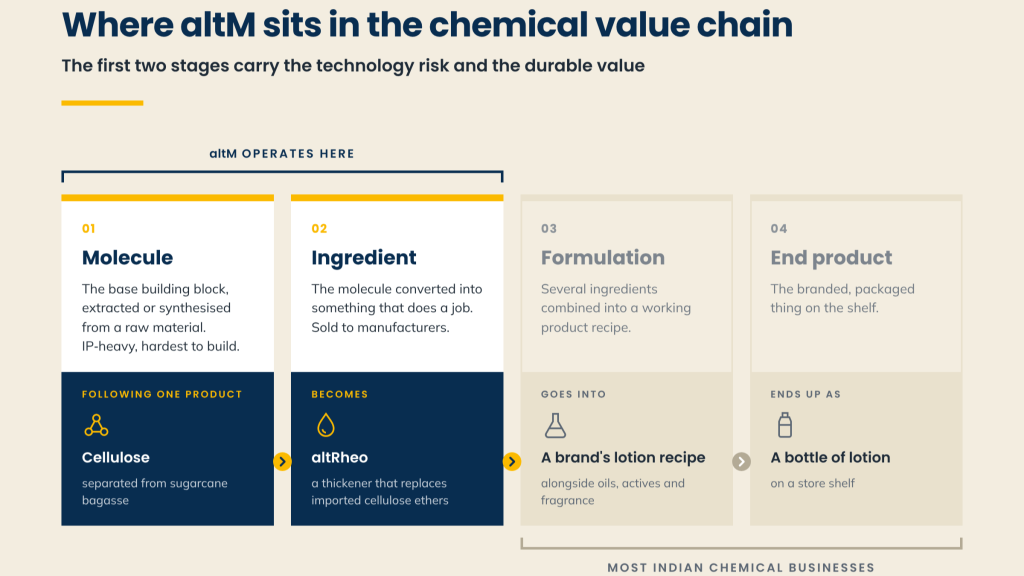
By innovating at the molecule layer and building it from a feedstock India produces and controls, altM can over time reduce India’s dependence on petrochemical imports.
Today, the company is working with sugarcane bagasse and waste lignin from 2G ethanol plants. It has moved from the lab to pilot scale, filed five patents in India and has successfully operated its continuous reactor for several weeks.
A few things stood out to us
I-Process and yield efficiency
The key point of interest for us is altM’s process and yield efficiency. Its process runs at low temperature and ambient pressure, which keeps both energy costs and reactor capex down. It does not rely on fermentation which makes scale-up more predictable.
The bigger difference is yield. Most current uses of agricultural residue, such as 2G ethanol and biogas, turn a tonne of biomass into one low-value output. altM recovers multiple fractions from the same tonne and sells each into specialty markets at its own price point. Today, it recovers two of the three fractions with R&D underway on the third.
As a result, the value altM realises from a tonne of residue is ~3-6x that of 2G ethanol and ~8-20x that of biogas.
“More value from every tonne of feedstock, produced at lower cost – this is what makes the economics work.”
II-A platform, not a single product
altM is not building one molecule. The same process can yield multiple molecules from the same feedstock, and each has the potential to become a ₹200-300 Cr P&L on its own.
It has started with Beauty & Personal Care, where ingredients are high-value, qualification-led and relatively low-volume. The portfolio has two kinds of products:
- Drop-in replacements substitute for an ingredient formulators already use, so the switch is decided on price, supply and quality.
- Category innovators create a new function in the formulation, and open markets that do not exist today.
In both cases, the products win on economics and performance, not only on sustainability. The current portfolio shows this:
- altScreen (category innovator), a lignin-based SPF booster. It lets formulators achieve the same SPF with roughly half the UV filters, one of the most expensive components of a sunscreen, which cuts formulation cost by ~20%.
- altRheo (drop-in), a cellulose-based thickener replacing cellulose ethers, of which India imports ~₹3,500 Cr a year. It offers a domestic source at price parity with much shorter lead times.
- altAegis FA (drop-in), high-purity ferulic acid. Most of India’s requirement is imported from Japan, and formulators report consistency issues. altM supplies it at 99.5% purity from a domestic source.
“Sustainability can accelerate adoption, but products ultimately need to win on performance and economics.”
altM has already signed its first sales agreements and is working with several brands and formulators, including global majors.
III-The team combines manufacturing and scientific depth
The founders, Apoorv Garg and Yugal Raj Jian come from manufacturing backgrounds and have approached the problem with a factory operator’s mindset – thinking about process, throughput, consistency and cost from the beginning.
They complemented this with deep scientific expertise. Dr. Harshad Velankar, who played a key role in architecting HPCL’s 2G bioethanol technology, joined altM after spending two decades in the industry. The broader team brings experience across chemistry, process engineering and plant operations.
“The challenge is not just discovering a molecule, but producing it consistently and economically at scale.”
For us, this combination of technology depth and manufacturing execution is particularly important in this business.
IV-Capital-efficient approach to building the platform
altM has already reached pilot scale and taking a capital-efficient approach to commercialisation.
Rather than building every part of the manufacturing infrastructure itself, it plans to add a bolt-on lignin unit at an existing 2G refinery and use established Indian chemical manufacturers for toll production of cellulose-based products.
We believe this is important for a business where scaling manufacturing can otherwise become extremely capital intensive.
Why Now?
Three things have come together.
First, the feedstock exists at scale.
India generates hundreds of millions of tonnes of agricultural residue every year, much of which has limited economic value today. This gives India a large, distributed and renewable feedstock base to build a new chemicals value chain around. The opportunity is not constrained by the availability of the raw material – the challenge is converting it economically and consistently.
Second, the demand is moving in the same direction.
Global customers are increasingly looking for bio-based, traceable alternatives to petrochemical inputs, while India is building capabilities in high-value bio-based chemicals through initiatives such as BioE3.
Third, the economics are beginning to work.
Historically, biomass fractionation struggled because the process was too energy- and chemical-intensive, making the resulting molecules difficult to compete with petrochemical alternatives. Improvements in process technology are changing that equation.
For us, this convergence is what makes the opportunity particularly interesting today: a large and underutilised feedstock base, growing demand for alternatives, and improving process economics.
Why it fits our thesis
At Mela, we look for B2B technology businesses where a deep technical moat can translate into a large commercial opportunity.
“India has an opportunity to build globally relevant chemical and materials businesses by leveraging something it has in abundance – its agricultural residue.”
altM is building exactly that, converting that residue into higher-value molecules. We are excited to partner with Apoorv, Yugal and the entire altM team as they build this platform.